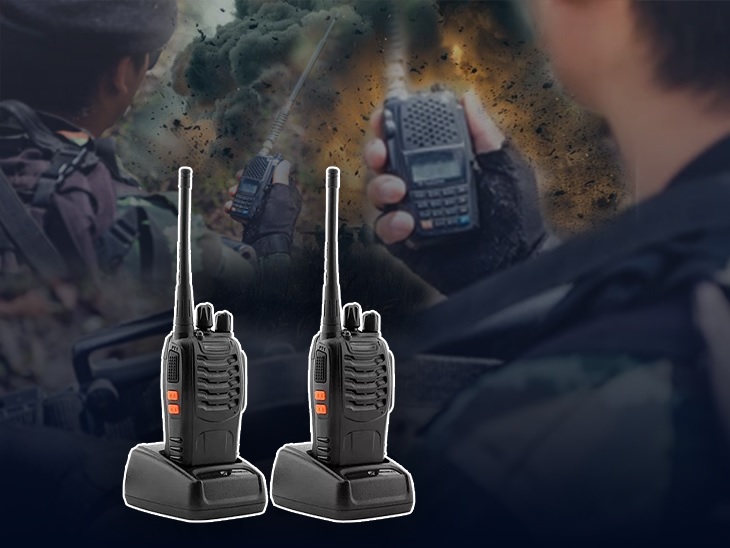
The power flickers. Cell service disappears. Suddenly, your phone is good for two things: taking photos and making you panic.
No calls. No texts. No signal.
Now picture this: you press a button on your walkie-talkie and say, “Team 1, report status.” You get an answer. Instantly.
No lag. No outage. Just communication that works.
This is exactly why walkie-talkies are still a vital part of emergency preparedness, industrial operations, event coordination, and outdoor expeditions. They operate on a completely different system—one that doesn’t rely on cell towers at all.
No Towers, No Problem
Here’s the key difference:
Cell phones route your call or text through a network of cell towers. If the towers are down—due to storms, power outages, cyberattacks, or overcrowding—your phone is effectively cut off.
Walkie-talkies, on the other hand?
They use radio frequency communication, meaning devices connect directly to each other on a shared channel.
- No infrastructure needed
- No subscription required
- No reliance on external signals
In short: they talk to each other without asking for permission from a tower.
Made for the Moments When Phones Fail
Natural disasters don’t ask for your availability.
Hurricanes, wildfires, and blackouts can wipe out power grids and cell service in minutes. First responders, utility crews, and safety coordinators don’t have time to wait for bars to return.
That’s why walkie-talkies are often part of critical communication systems:
- They function independently of commercial networks
- They don’t collapse under stress or traffic
- They operate as long as they’re powered on and within range
In these moments, being able to press a button and speak instantly isn’t a luxury—it’s essential.
Why Walkie-Talkies Aren’t Just “Old Tech”
Let’s be real: some people think of walkie-talkies as relics from summer camp. But modern units are sophisticated, durable, and purpose-built for high-stakes environments.
They support:
- Long-range communication across buildings or job sites
- Noise cancellation for loud surroundings
- Encrypted channels for secure team chatter
- Battery life that lasts all shift (or longer)
And unlike phones, they don’t suddenly go quiet when the grid goes dark.
They Bypass the Bottlenecks
In an emergency, everyone grabs their phone. Networks clog. Towers crash.
Meanwhile, walkie-talkie users are calmly coordinating in real time.
That’s because:
- They don’t compete for bandwidth
- They don’t need internet or apps
- They’re not affected by digital congestion
It’s the equivalent of driving on a private lane while everyone else is stuck in traffic. You don’t even notice there’s a jam.
A Built-In Advantage: Simplicity
There’s something beautifully reliable about a device with one job: transmit voice fast and clearly.
No login. No software update. No password reset.
Just:
- Push to talk
- Release to listen
- Repeat as needed
In chaotic situations, simplicity wins. And walkie-talkies deliver exactly that—no-fuss communication that never goes out of style.
Final Thought: When the Grid Goes Down, Radios Stand Up
Cellular networks are powerful—but fragile. A storm, a fire, or a sudden surge in traffic, and they’re toast.
Walkie-talkies? Still standing. Still speaking. Still connecting people when other systems fall apart.
Because in a world built on complex tech, sometimes the simplest tools are the ones you can actually count on.